
How to convert a date and time across time zones
Learn how to convert a date and time between time zones step by step, avoid daylight saving and date line mistakes, and check your result in seconds.
Published · Updated
Why the date matters, not just the time
“3 PM in New York” does not map to one fixed time in London, Kolkata or Sydney. The gap between two places depends on the date, because many places move their clocks for daylight saving and they do not all do it on the same day. A conversion that was right in July can be an hour out in November.
So the first rule is simple: always convert a date and a time together. Once you know the exact day, the rest is arithmetic.
The quick method in three steps
- Find each place’s UTC offset on that date. For example, New York is UTC−4 in summer (EDT) and UTC−5 in winter (EST). India is UTC+5:30 all year.
- Work out the difference. From UTC−4 to UTC+5:30 is 9 hours 30 minutes.
- Add or subtract, then check the day. 3 PM in New York on Friday 30 October 2026 plus 9:30 is 12:30 AM, which is past midnight, so in India it is Saturday 31 October.
That last check is the one people skip. If you want to confirm your answer, type the same date and time into the date and time zone converter.
Daylight saving pitfalls
- Different switch dates. In 2026 the US moves its clocks on 8 March and 1 November, while the UK and EU move on 29 March and 25 October. Between those dates the London and New York gap is 4 hours instead of the usual 5.
- Places that never switch. India, Japan, China and many others keep the same offset all year, so their gap to Europe or North America changes when the other side switches.
- The southern hemisphere runs the other way. Places such as Sydney move their clocks forward around October and back around April, so a gap to Sydney can change twice in a few weeks.
For a recurring meeting, check the time again near each clock change instead of assuming the old gap still holds.
EST vs EDT and other abbreviations
Abbreviations cause more mix-ups than the maths. Many people write EST all year, even in summer when New York is actually on EDT. The same goes for PST and PDT, or GMT and BST. If you take “EST” literally on a summer date, you will be an hour off.
Naming the city avoids the problem. If you do type an abbreviation into the MeetETA converter on a date when it does not match the season, a short note tells you which time it used.

Crossing midnight and the date line
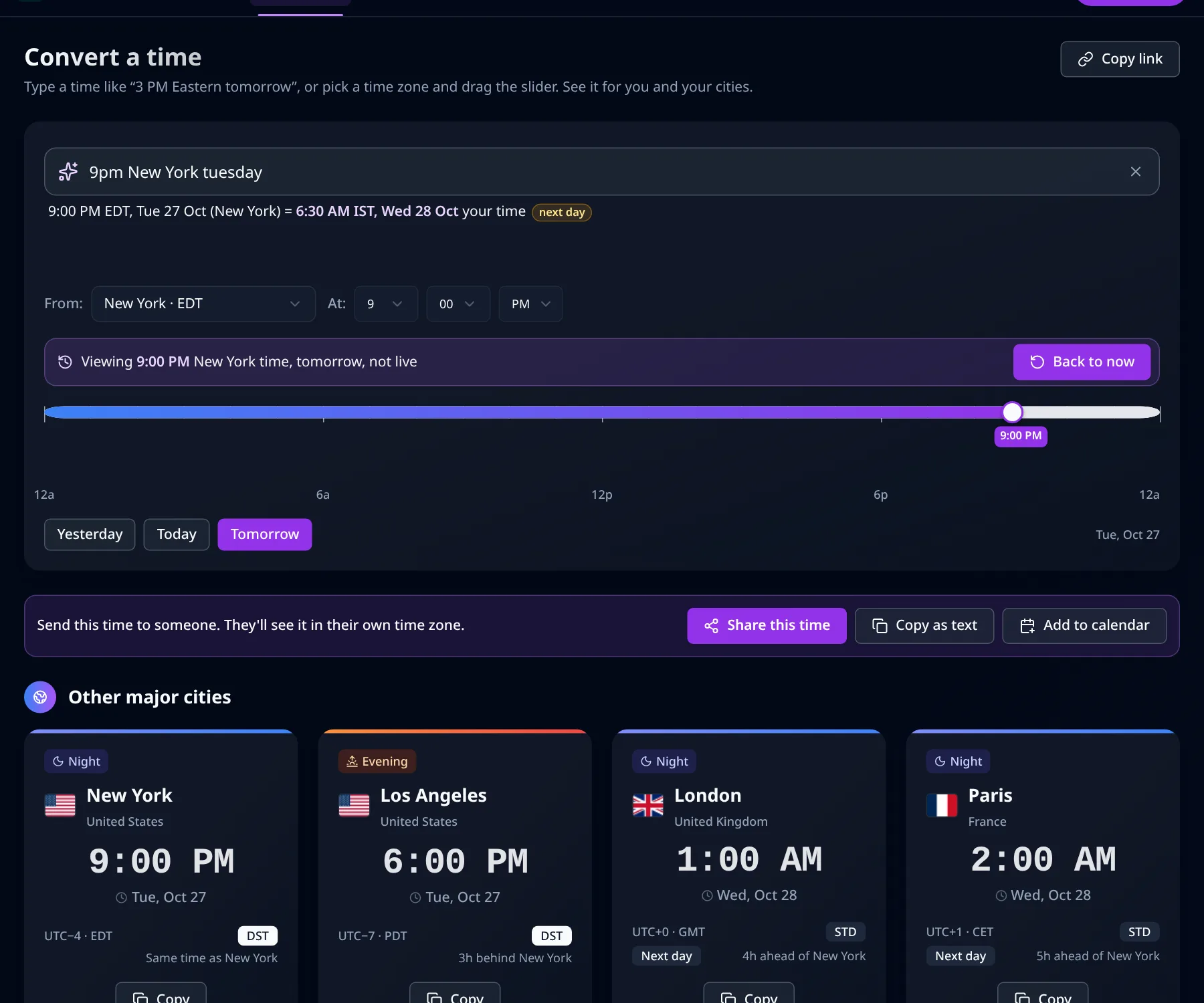
An evening in the Americas is often the next morning in Asia and Australia. For example, 9 PM on Tuesday 27 October 2026 in New York is 6:30 AM on Wednesday 28 October in Kolkata. If you invite someone for “Tuesday at 9 PM” without saying whose Tuesday, one of you will turn up on the wrong day.
The international date line makes this more extreme. Places just west of it are among the first to start each new day, while places just east of it are among the last, so their dates can differ for most of the day.
Writing a time so nobody gets it wrong
- Include the full date, not just a weekday.
- Name the city or zone, for example “3 PM New York time”.
- Add the other person’s time when you know it: “3 PM New York, 12:30 AM Saturday in Kolkata”.
- For a group, pick a slot that falls inside everyone’s working hours with the meeting planner across time zones.
Doing it in seconds with MeetETA
On the converter, type the date, time and place the way you would say them, such as “10am New York next Tuesday”, “3pm London 13 Oct” or “9am London to Tokyo”. Each city then shows its own date and time for that moment, with daylight saving worked out for the day you chose. It is free and needs no sign-in.
When times turn up in emails or web pages, the MeetETA extension for Chrome converts a selected time into your zone without leaving the page.
Convert any date and time in seconds
Type a date, time and city and see it in your time and your team’s cities, free and with no sign-in.
Common questions
How do I know if a time zone change moves the date?
Add or subtract the difference between the two places. If the result goes past midnight, the date moves forward one day. If it goes back past midnight, it moves back one day.
Why is the difference between two cities sometimes an hour off?
One of them has changed its clocks for daylight saving and the other has not yet, or does not change at all. Check the offsets for the actual date, not the usual gap.
Is EST the same as Eastern time?
Not all year. EST is the winter name. In summer the eastern US is on EDT, one hour later. Many people write EST all year, so name the city when the exact hour matters.
What is the safest way to share a meeting time across time zones?
Write the full date, the time and the city or zone, and add the other person’s time if you know it. Or send a link that shows the time in each viewer’s own zone.
Can two places really be a whole day apart?
Yes. Some Pacific islands sit 14 hours ahead of UTC while places on the other side of the date line sit 10 or 11 hours behind, so for part of each day their calendars show different dates.