
Scheduling online lessons across time zones: a complete guide for online tutors
A lesson is one moment in time, shown on two clocks. Write every time with a date and both cities, for example “Tuesday 4:00 PM London / 11:00 AM New York”, decide whose clock a weekly lesson follows, and give students a way to see the time in their own zone. Watch the weeks when the US and the UK or EU change clocks on different dates, because a weekly slot that is comfortable in January can land an hour off in March.
Published · Updated
Why lesson times go wrong
Independent language tutors, coaches with clients abroad, and music or test prep teachers often work with students many hours away. A Thursday trial with a student in New York, a Saturday slot with a parent in Dubai, and a weekly Tuesday with a teenager in Sydney can all live on the same calendar.
The usual failure is not a wrong conversion on the day you first agree the time. It is a message that says only “4 PM on Tuesday”, a weekly invite that nobody checks when the clocks change, or a student who converts from memory using last winter’s gap. The student sits down an hour early, or an hour late, and someone loses a lesson.
This guide is about preventing that. It covers whose time should count, how to write a time so nobody has to do the math, why a booking link that shows the student’s local clock is the cleanest fix for trials and reschedules, and the daylight saving calendar that moves a standing weekly lesson.
Whose time counts
A lesson happens at one instant. 4:00 PM in London and 11:00 AM in New York can be the same moment. Neither clock is more real than the other. What you choose is which clock the lesson is pinned to, and which times you write down for each person.
For the student, especially a child or teenager, local time is what the rest of the day is built around: school ending, a commute, dinner, bedtime. A 4:00 PM lesson that quietly becomes 5:00 PM after a clock change can collide with all of those. For you, the constraint is the hours you actually teach and the breaks you need between students.
A clear way to settle this:
- For a one-off trial or a reschedule, write both times and, when you can, let the student pick from a list that is already in their zone.
- For a weekly lesson, pick an anchor clock and write it into the first message and the calendar event, for example “Tuesdays at 4:00 PM New York time”.
- For school-age students, make the student’s clock the anchor. Their 4:00 PM stays 4:00 PM when their country changes clocks, and you, as the professional, absorb the shift on your side. For adult coaching, either side can be the anchor, as long as both of you know which it is.
- When a parent or student asks “can we do 4?”, always ask 4 in which city. A 4:00 PM that is afternoon in New York is late evening in London and early morning in Sydney.
If one of you lives in a place that never changes clocks, such as India, Singapore, the United Arab Emirates, Queensland or Western Australia, that person’s wall clock is stable all year. That does not mean their partner’s time is stable. The gap still moves when the other country changes, and that is the side that needs a heads-up.
How to write a lesson time
The safest line you can send is a date, a clock time, and both cities:
Tuesday, February 3, 4:00 PM London / 11:00 AM New York
A few rules make this reliable:
- Always include the date. “4 PM London” is not enough near a clock change, and for a student in Sydney or Singapore your Tuesday evening can be their Wednesday morning.
- Name the city, or a neutral zone label such as Eastern Time (ET), rather than a seasonal abbreviation. “3 PM EST” in July names a time no New York clock shows, and a student who converts it as five hours behind UTC arrives an hour late. “3 PM New York” or “3 PM ET” is never wrong.
- Put both times in the WhatsApp or email message, not only in a calendar invite. Many students and parents read the chat and never open the invite.
- Still send a calendar invite when you can. A proper event, stored in one time zone, shows each person their own local time in Google Calendar, Outlook or Apple Calendar. The written line is the backup for everyone who looks only at the message.
- For a trial with a parent on the call, write the child’s city and the parent’s city if they differ, for example a child at boarding school in one country and a parent at home in another.
That London and New York example is correct through most of the year, including midwinter and midsummer, because both places usually move their clocks in the same season. It is not correct in the awkward weeks between their change dates. On Tuesday, March 17, 2026, 4:00 PM London is 12:00 PM EDT in New York, not 11:00 AM. Those weeks are covered below.
Let students see the time in their own zone
The cleanest way to stop conversion errors is not a better explanation. It is a page or a link that already shows the student their local time.
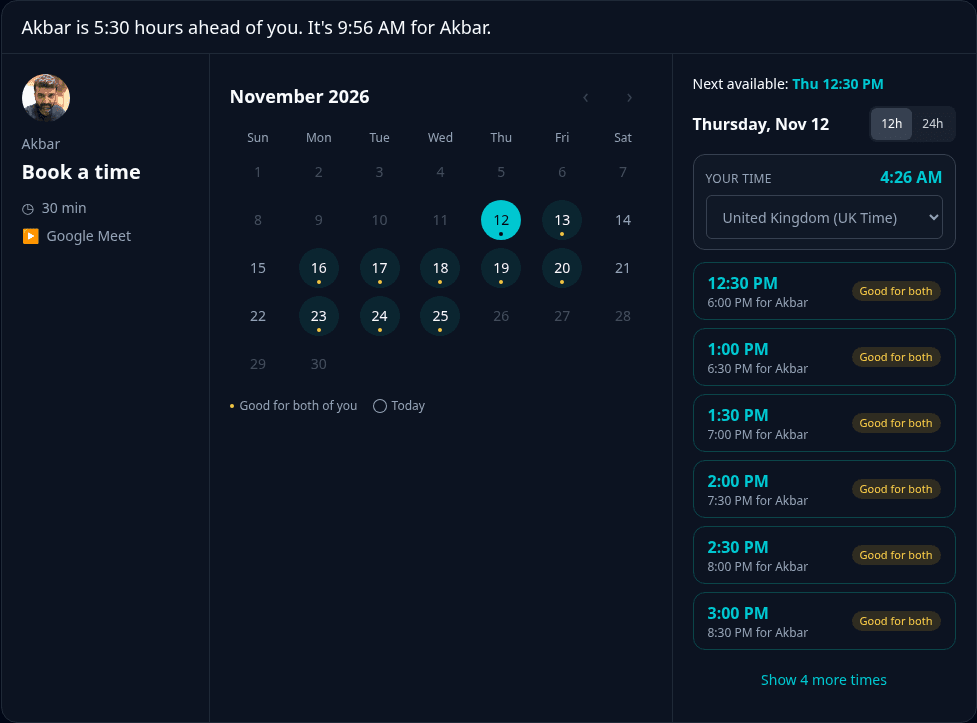
Most booking tools, such as Calendly, Cal.com and TidyCal, also show visitors times in their own zone. When you choose one, check that the offset is worked out for the lesson date, that there is a zone picker so a student can correct a wrong guess, and that your time is visible too.
When someone in Toronto opens your scheduling link, 9:00 AM Toronto should be the number they click. Your Dubai time can sit next to it so both of you can confirm you mean the same moment.
This is especially useful for trial lessons with new students who do not yet have a standing slot, for reschedules after a cancellation or a holiday, and for adult clients who book when they have a gap rather than every week at the same time.
A standing weekly lesson is often still agreed by hand and stored as a repeating calendar event. Some scheduling tools, including Calendly, Cal.com and Acuity Scheduling, can repeat a booking automatically. If you use a weekly calendar event instead, the writing rules above still apply, and you should re-check the event in the weeks around each clock change.
Daylight saving and the weeks that move a weekly lesson
Daylight saving is the main reason a lesson that has run at the same local times for months suddenly misses. The United States, the United Kingdom, the European Union and Australia all change their clocks, but not on the same dates, and not always in the same direction. India, Singapore, the United Arab Emirates, Queensland and Western Australia do not change at all.
The United States and most of Canada move clocks forward on the second Sunday in March and back on the first Sunday in November, at 2:00 AM local time. The UK and the EU move forward on the last Sunday in March and back on the last Sunday in October, at 1:00 AM UTC. In the southern hemisphere the seasons run the other way, so New South Wales, Victoria, the Australian Capital Territory and Tasmania go back on the first Sunday in April and forward on the first Sunday in October. Queensland and Western Australia stay on standard time all year.
| Region | Clocks go forward | Clocks go back | 2026 dates | 2027 dates |
|---|---|---|---|---|
| United States and most of Canada | 2nd Sunday in March | 1st Sunday in November | March 8 and November 1 | March 14 and November 7 |
| United Kingdom | Last Sunday in March, at 1:00 AM UTC | Last Sunday in October, at 1:00 AM UTC | March 29 and October 25 | March 28 and October 31 |
| European Union | Last Sunday in March, at 1:00 AM UTC | Last Sunday in October, at 1:00 AM UTC | March 29 and October 25 | March 28 and October 31 |
| Australia (NSW, Victoria, ACT, Tasmania) | 1st Sunday in October | 1st Sunday in April | Back April 5, forward October 4 | Back April 4, forward October 3 |
| Queensland and Western Australia | No change | No change | AEST (UTC+10) and AWST (UTC+8) all year | AEST (UTC+10) and AWST (UTC+8) all year |
| India, Singapore and the UAE | No change | No change | IST (UTC+5:30), SGT (UTC+8) and GST (UTC+4) all year | IST (UTC+5:30), SGT (UTC+8) and GST (UTC+4) all year |
South Australia uses the same change dates as New South Wales, on its own offset. The Northern Territory, like Queensland and Western Australia, does not observe daylight saving. In North America, Arizona (outside the Navajo Nation) and Saskatchewan stay on standard time all year, so a student there will not move with New York or Toronto.
The awkward weeks between the US and the UK or EU
The stretches that catch tutors out are the weeks when the US has changed and the UK or EU has not, or the other way around. During those weeks the usual five-hour gap between New York and London shrinks to four. A Tuesday 4:00 PM London lesson, which is 11:00 AM in New York for most of the year, becomes 12:00 PM in New York.
- March 8 to 28, 2026: New York is already on Eastern Daylight Time, London is still on Greenwich Mean Time.
- October 25 to 31, 2026: London has gone back to GMT, New York is still on Eastern Daylight Time.
- March 14 to 27, 2027: the same spring mismatch in 2027, after the US changes on March 14, 2027 and before the UK and EU change on March 28, 2027.
- October 31 to November 6, 2027: the same fall mismatch, after the UK and EU change on October 31, 2027 and before the US changes on November 7, 2027.
Here is that weekly Tuesday 4:00 PM London lesson with a New York student, through the 2027 changes. The times are computed from time zone data for each date:
| Tuesday | What is happening | London | New York |
|---|---|---|---|
| February 2, 2027 | Winter, both on standard time | 4:00 PM GMT | 11:00 AM EST |
| March 16, 2027 | Awkward week: US already on daylight time, UK not yet | 4:00 PM GMT | 12:00 PM EDT |
| March 30, 2027 | Summer, both on daylight time | 4:00 PM BST | 11:00 AM EDT |
| November 2, 2027 | Awkward week: UK back on GMT, US still on daylight time | 4:00 PM GMT | 12:00 PM EDT |
| November 9, 2027 | Winter again, both on standard time | 4:00 PM GMT | 11:00 AM EST |
If the lesson is anchored to London, the New York student is the one who sees a different local time in the awkward weeks. If it is anchored to New York, you are. Either is fine, as long as you message them a week ahead and offer to move the slot if the new time is a bad fit for school or work.
The rest of the EU follows the same change dates as the UK, so a New York and Berlin lesson drifts the same way, from six hours to five. Paris, Amsterdam, Rome and other EU cities sit in that same pattern.
Australia adds a further twist because it moves in the opposite season. The gap between Sydney and London changes four times a year: late March (UK forward), early April (Sydney back), early October (Sydney forward) and late October (UK back). Queensland tutors teaching students in Sydney or Melbourne are an hour apart during Australian daylight saving, from early October to early April, and on the same clock the rest of the year.
Places that never change, including Singapore, Dubai, India and Queensland, only see the gap move when the other person does. The pairs below show how that looks for a regular lesson.
London and New York
A Tuesday 4:00 PM London lesson is 11:00 AM in New York for most of the year, including midwinter and midsummer. In the awkward weeks it is 12:00 PM in New York.
| Date | London | New York |
|---|---|---|
| Tuesday, February 3, 2026 | 4:00 PM GMT | 11:00 AM EST |
| Tuesday, March 17, 2026 (awkward week) | 4:00 PM GMT | 12:00 PM EDT |
| Tuesday, July 7, 2026 | 4:00 PM BST | 11:00 AM EDT |
London and Sydney
A Wednesday 8:00 AM London lesson, a comfortable morning for a UK student, falls in the Sydney evening. Because Australia and the UK change clocks in opposite seasons, and on different dates, the Sydney time moves more than once a year.
| Date | London | Sydney |
|---|---|---|
| Wednesday, January 14, 2026 | 8:00 AM GMT | 7:00 PM AEDT |
| Wednesday, July 8, 2026 | 8:00 AM BST | 5:00 PM AEST |
| Wednesday, October 7, 2026 | 8:00 AM BST | 6:00 PM AEDT |
Singapore and Toronto
Singapore never changes its clocks, so only Toronto’s daylight saving moves this pair. An 8:00 PM Singapore lesson is 7:00 AM in Toronto in January and 8:00 AM in July.
| Date | Singapore | Toronto |
|---|---|---|
| Wednesday, January 14, 2026 | 8:00 PM SGT | 7:00 AM EST |
| Wednesday, July 8, 2026 | 8:00 PM SGT | 8:00 AM EDT |
Dubai and Berlin
The United Arab Emirates stays on Gulf Standard Time all year. A 7:00 PM Dubai coaching session is 4:00 PM in Berlin in January and 5:00 PM in July, after Europe moves its clocks.
| Date | Dubai | Berlin |
|---|---|---|
| Wednesday, January 14, 2026 | 7:00 PM GST | 4:00 PM CET |
| Wednesday, July 8, 2026 | 7:00 PM GST | 5:00 PM CEST |
A converter or a booking page is only safe through these weeks if it uses time zone data for the date of the lesson, not the gap that is true today. MeetETA does that: its converter and meeting planner compute the offset for the date you enter, and its booking pages follow your hours on each date and note when clocks change that week in your zone or the student’s.
For a fuller clock-change calendar and a routine for recurring calls, see avoiding daylight saving mistakes when scheduling international calls. For the November 2026 US change, see the November 2026 daylight saving recap. To convert one time, use the time zone converter, or read how to convert a date and time across time zones. To find a standing slot that sits inside both people’s hours, the meeting planner and the guide to finding a meeting time across time zones walk through the method.
A year-round routine for tutors
- Decide the anchor clock for every standing lesson and write it down, with both cities, in the first message and in the calendar event.
- Send times in the form “Tuesday, February 3, 4:00 PM London / 11:00 AM New York”, including the date.
- Give new students, and anyone who needs to reschedule, a link that already shows times in their zone.
- Set reminders for the second week of March and the last week of October, which cover the US, UK and EU changes, and for early April and early October if you teach students in Australia.
- A week before each of those dates, look at the next lesson on its real date, tell the student the time in their zone, and offer a different slot if the new time is awkward.
- After a change, do not assume last season’s gap. Convert that week’s date, or open the lesson in a tool that already does.
Doing this in MeetETA
On a MeetETA booking page, a student sees open times already converted to their own time zone. A picker at the top lets them change the zone if the page guessed wrong, and your local time sits under each slot. Open times follow your teaching hours on each date, and the page notes when clocks change that week in your zone or theirs. Booking is part of MeetETA Pro. A free time link, which anyone can create, shows your time zone and hours in the visitor’s zone, without taking bookings.
Share a free time link your students can open in their own zone
Your free MeetETA link shows your time zone and working hours, and the hours of overlap in the student’s zone. Students cannot book a lesson from it. If you want them to pick a time themselves, MeetETA Pro adds a booking page for $5.99 a month, or $79 once. The $79 price holds until the January launch, when it becomes $99.
Create a free time link